For optoelectronics specialists, pulse-based tunable lasers must be flexible enough to produce wavelengths across a broad spectrum from visible light to deep UV, in high intensity bursts measured in nanoseconds. Pulse-based tunable lasers can transmit information over fiber, desorb ions and generate heat that is converted to ultrasonic waves, or excite electrons. Their flexibility enables lasers to play a critical role in time-resolved physical chemistry, mass spectrometry, photoacoustic imaging, spectroscopy, spectrophotometry, diagnostics, and hyperspectral imaging.
 Among the most flexible and inexpensive pulse-based lasers are Optical Parametric Oscillators (OPO) lasers that can be “tuned” to a wide spectrum of specific wavelengths.
Thanks to more than 35 years of development, OPO lasers are a commercial reality. From the early days as a large, easily misaligned system developed and sold out of a garage, OPOs are now fully integrated, off-the-shelf devices. And they no longer require a laser engineer to set up and calibrate. Today’s OPOs are readily installed and controlled in an OEM’s system.
“Off-the-shelf OPOs are designed specifically for those who don’t know much about optics or how to tune a laser,” says Dr. Mark Little, Technical and Scientific Marketing Consultant for Carlsbad, CA-based OPOTEK LLC, a global manufacturer of tunable lasers. “Basically, it is a black box that can be integrated into another black box that is being developed.”
Automation now controls all system elements, such as the pump laser harmonics, crystal rotation for optics adjustment, waveform separation optics, and attenuators. Product developers can also incorporate the software functionality features of the OPO into their own software using software development kits.
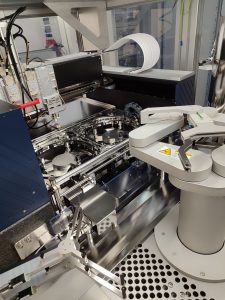 “For research scientists or companies utilizing this laser in their products, having separate control software from the tunable laser manufacturer may not be ideal. They prefer to integrate all controls into their own software. In academic settings, saving all data with laser parameters is crucial for seamless operation. Integration is key for everything to function cohesively,” explains Dr. Little.
Integrating automation and control is important as often lasers are enclosed within a larger housing, making it difficult to access for reprogramming or repair.
A software development kit can also be used to set up programmable scans with pre-determined wavelengths in any order. This has applications in advanced, high-resolution imaging. The inherent focusability of lasers enables them to sample incredibly small size areas, measured in tens of micrometers. By pre-programming the laser, the system can raster and move the laser to different areas to produce high resolution scans.
“Since it is a pulse laser that lases many times per second, you can enter the number of times you want it to fire at each wavelength and determine how much to increase or decrease the wavelength,” says Dr. Little. “All the high- powered beams now come out of a single port, allowing the operator to directly target the area of interest for analysis.”
Size matters with tunable OPO lasers. If an OPO is oversized, instrument integration will be more difficult, and the overall final product footprint large. This can be significant given research lab spatial requirements.
Today, OPOTEK offers one of the smallest tunable lasers commercially available, the ‘shoebox’ sized Opolette 2940. While still requiring a ‘briefcase’ sized power supply with internal water-cooling, the 2.94 micron OPO laser has a laser head footprint of only 9.5 x 4.5 x 7.5 inches,
According to Dr. Little, the small size increases the rigidity of the laser, further stabilizing the component parts within the integrated housing.
One notable feature of the modern OPO is the ability to transmit various wavelengths through fiber optics. Fiber optics has emerged as the primary method for transmitting laser light due to its ease of setup and disconnection. Moreover, it safeguards end users from light exposure or eye contact, as the light is conveyed through an enclosed conduit. OPOTEK provides fiber delivery for all its products, irrespective of the energy levels.
For more information, call 760-929-0770 or visit www.opotek.com.