
The UK lags behind the rest of the world on automation. According to the International Federation of Robotics’ (IFR) 2025 World Robotics report, Britain ranked 19th worldwide in robotic installations.
In sectors where adhesive dispensing is a routine part of assembly, that gap represents a real competitive disadvantage. Here, Matt Baseley, head of sales at adhesives and dispensing systems supplier Intertronics, examines ten reasons for investing in automation.
- Getting started is straightforward with the right supplier
Installation, programming and commissioning are legitimate considerations for first-time buyers. The answer is to choose a supplier like Intertronics that is an expert in adhesives first — one that can integrate the two disciplines and provide training to instil confidence in the operating team.
- The return on investment can come quickly
ROI on dispensing robots can be achieved in as little as six months, and almost always within two years. Crucially, the time to value is immediate: from the moment a system is installed and running, the manufacturer benefits from improved throughput, reduced waste and more consistent output.
- Robots can be acquired at sensible costs
Entry-level dispensing robots start at around £6,000. A complete installation — including enclosures and ancillary equipment — typically comes in between £10,000 and £20,000. For a system that might run day in and day out across a production line, that is a modest outlay: less than the managing director’s new car!
- Performance can be proven before you commit
A good automated dispensing supplier will support trials before any purchase decision is made. Intertronics operates a Technology Centre in Oxfordshire where customers can visit and run their own processes on equipment they’re considering. This kind of evidence-based approach to the investment decision removes the guesswork entirely.
- Robots are highly flexible assets
Modern dispensing systems are designed to be reprogrammed and redeployed. A system specified for one adhesive application today can be retooled for a different process tomorrow — sometimes with nothing more than a tooling change and a new programme.
- Robots deliver value even when used selectively
Most users do not run their dispensing robots around the clock, and they do not need to. A robot deployed for a single shift, or brought into use for specific batch runs, still delivers the speed and consistency advantages that manual dispensing cannot match.
- Robots improve health and safety
Safety enclosures are standard on dispensing robot installations. A 2026 IFR research paper shows that automation typically delivers a net improvement in workplace health and safety: fatality and injury rates across 18 EU countries fell by 4.3 per cent and 3.2 per cent respectively between 2011-2019.
- Robots improve job satisfaction
The 2025 paper ‘Human factors in digital manufacturing technology adoption: a workforce perspective’ found that workers in manufacturing companies where digital manufacturing technologies (DMTs) have already been implemented reported increased skills, autonomy and number of interesting tasks, as well as decreased fatigue levels, physical workload, and stress.
- Robots create jobs
2025 research by Fang et al., published in Asia and the Global Economy, shows that increased industrial robot installation is associated with a reduction in unemployment. Competitive manufacturers grow, and growing manufacturers hire. Dispensing robots move people away from repetitive, chemical-adjacent tasks and into work that is more skilled, varied and fulfilling, improving morale, staff retention and often company performance.
- Why wait?
Henry Ford put the underlying logic plainly: “If you need a machine and don’t buy it, then you will ultimately find that you have paid for it, but don’t have it.”
For manufacturers still running adhesive dispensing by hand, the case for automation is not about novelty or scale — it is about repeatability, waste reduction and building a production process that holds up as volumes grow and products change.
Not every dispensing application justifies automation. However, for manufacturers facing increasing quality, throughput, or labour challenges, it is worth examining whether a dispensing robot could deliver measurable benefits.
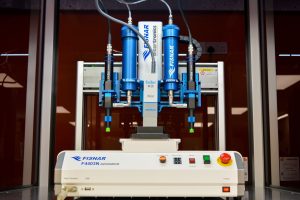 To find out more about how automated dispensing could increase your manufacturing throughput and improve your process repeatability, check out the following case study on the Intertronics website.
For more electronics updates please visit: https://efemag.co.uk/category/news