
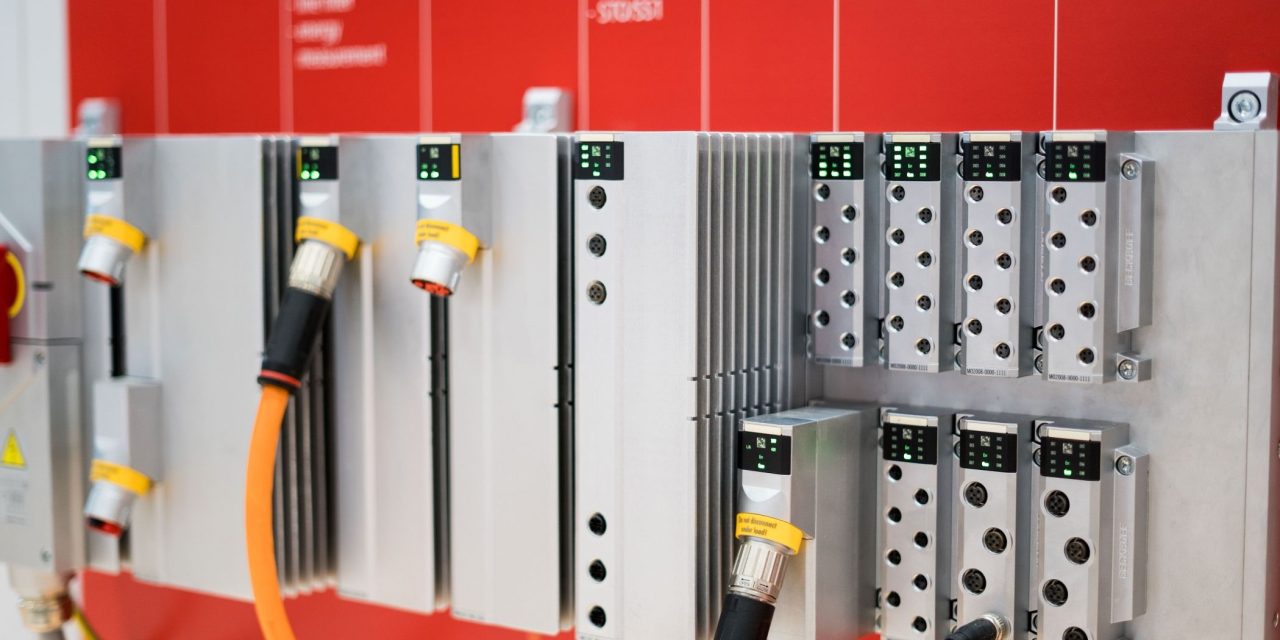
Control cabinets act as the control hub of any installation, housing and protecting devices needed to run machine and plant automation. Although this centralised approach has become the accepted standard, it isn’t without its complications. Here, Neil March, MX-System product specialist at Beckhoff Automation UK, explains how we can start thinking outside the box and alleviate the constraints of the control cabinets.
Every automated system needs some combination of industrial PC, PLC, power supplies, drives, I/O modules, relays, cables and cooling systems. With this many components, placing them together in a protected environment seems like the logical thing to do. Having everything in one place provides a good overview, while sparing multiple protective and cooling devices.
Yet with rising demands in modern manufacturing, this centralised approach comes with inherent complexity. Every machine part that needs power and data must be connected to the cabinet via cables, each of which requires indent crimping, termination and testing. For large-scale projects, this can involve over a thousand parts, which puts a strain on the level of skill and equipment that the company has. This means that cabinets must be carefully designed and tested, while the right components are procured and assembled.
Lesser known is that installation effectively happens twice. First, the cabinet is assembled at the system integrator or OEM’s site, then, it must be transported, reinstalled and reconnected at the end-user’s facility. In a modern production environment, where speed, flexibility and scalability are increasingly vital, conventional control cabinets can bottleneck operations.
What’s outside the box?
The prospective benefits of cabinet-free automation are very attractive. At the most basic level, they take up valuable floor space, which is real estate that could otherwise be used for production machinery or expansion. The requirement to position cabinets in close proximity also restricts layout flexibility and efficiency.
Moving away from cabinets also means reduced labour and hardware requirements, fewer components to procure and maintain as well as streamlined diagnostics that help prevent unplanned stoppages. This, alongside reduced shipping and installation complexity, frees up resources to be used in more pressing areas.
However, control cabinets still serve an important function and there is no incentive to abandon them if the alternative is not as effective. The external casing is in place for sensitive electronics to be safeguarded against dust, moisture and vibration (IP54 or higher). It can also house cooling equipment to dissipate the heat generated by the components in a safe and efficient way. Compliance also comes into play, since all devices must meet the relevant international standards such as IEC, UL and CSA.
Overcoming these hurdles requires not just rethinking the cabinet but reimagining the entire control architecture.
Decentralised control and cabinet-free automation
To understand what decentralised control looks like, focusing on connectivity is key. Increasing parts of a modern systems demand reliable, high-speed data and power distribution, so cabling everything to a central point can get messy and end up being confusing to navigate.
Components can instead be daisy-chained as needed, where each device acts as a node and extends the reach further beyond where it started. EtherCAT P uses this concept, simplifying wiring complexity by also combining power and data into one connection.
When it comes to replacing the cabinet, Beckhoff’s MX-System is a good example to look at. Its robust IP67-rated housing means no external casing is required and instead can be directly mounted on the machine. This further reduces cabling concerns by bringing the automation platform closer to where it needs to be.
Fully modular and designed to deliver plug-and-play functionality, it also addresses scalability and flexibility concerns associated with cabinets. As requirements evolve, components like power supplies, I/O, servo drives etc. can all be combined and reconfigured. Even third-party components can be accommodated, with blank modules able to direct connections to other equipment.
Interacting with cabinet-free automation solutions is also typically less intense. With sophisticated diagnostics support like environment monitoring and predictive maintenance, costly downtime can be prevented by making proactive adjustments. With control automation software like TwinCAT, opportunities for new levels of efficiency are unlocked. Engineers can configure, program and monitor automation functions directly, while enabling each decentralised module to be seamlessly integrated into a wider machine architecture.
As manufacturers seek to optimise space, reduce complexity and improve uptime, decentralised automation presents a compelling alternative. Modular, cabinet-free design helps address the technical and practical challenges of moving away from control cabinets. For manufacturers competing in fast-moving markets, this is a pathway to more agile, scalable and efficient automation.
Read more about Beckhoff’s cabinet-free automation solution at https://www.beckhoff.com/
For electronics updates please visit: https://efemag.co.uk/category/news/