
At the University of California, San Francisco (UCSF), researchers are trialling a brain implant that can detect pain and deliver personalised relief, enabling one participant to hug his wife for the first time in years. While such breakthrough procedures capture headlines, their success depends on surgical instruments and the advanced components used within. Here, Dave Walsha, sales director at precision gearbox manufacturer Electro Mechanical Systems, explains how custom gearbox solutions are enabling advances in neurosurgery.
The human brain contains approximately 100 trillion neural pathways, 400 miles of small blood vessels, 12 pairs of cranial nerves, critical white and grey matter, ventricular system and cerebrospinal fluid (CSF) spaces, the brainstem and deep nuclei. This structural complexity and fragility within a densely packed space makes brain surgery one of the most technically demanding procedures.
For much of medical history, the success of brain surgery has relied on surgeons’ steady, unassisted hands. But as procedures have become more ambitious, from tumour resections to deep brain stimulation and implant placement, the limits of human dexterity have been reached, prompting the development of advanced tools, including microdrills, stereotactic robotic arms, multi-joined robotic manipulators and endoscopic systems.
The success of these tools depends not only on surgical planning or imaging guidance but also on how precisely they move. The slightest unintended motion could cause irreversible damage to critical neural structures. To minimise this risk, every movement, whether rotational, linear or articulated, must be smooth, precise and predictable. Ensuring this level of control starts with an instrument’s components.
Driving smooth, controlled motion
In neurosurgical instruments, motion must be both powerful and finely controlled. Brushless DC motors are often used because they deliver steady, low-speed rotation with very little cogging, making them well-suited for microdrills. Where movement needs to occur in small, discrete steps, such as positioning electrodes or adjusting the joints of robotic tools, miniature stepper motors are preferred.
However, on their own, even the most capable of motors cannot achieve the sub-millimetre precision required to navigate the brain’s densely packed structures during surgery.
A gearbox is used to reduce the motor’s speed while amplifying its torque, allowing instruments to move deliberately and predictably. In general, industrial environments, standard gearboxes are often sufficient for the task at hand. However, in neurosurgery, standard components aren’t enough.
 Meeting surgical demands
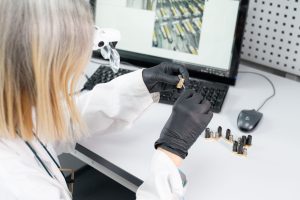
Neurosurgical procedures demand instruments capable of exceptionally smooth and repeatable motion, extreme positional accuracy and compact designs that can withstand repeated sterilisation. Custom precision gearboxes are engineered to meet these exacting requirements.
The motion predictability and fluidity of a gearbox is influenced by factors such as gear tooth geometry, bearing alignment and the tolerances of key internal components, including gears, pinions, shafts and housing bores. These elements can be refined to enhance motion stability and maintain smooth, controlled movement.
For example, gear tooth profiles can be finely ground to ensure they mesh smoothly, reducing vibration that could otherwise be transmitted to the instrument tip. Shafts and bearings can also be carefully aligned to limit deflection, keeping rotation steady even under the small but significant forces generated when a motor drives the instrument or when the instrument interacts with neural tissue.
To further stabilise movement, flexure-based compliance mechanisms can be incorporated. These allow the gearbox to absorb microscopic shifts and maintain smooth, controlled rotation and linear motion, essential when operating near delicate neural structures.
With motion stabilised, the next challenge is achieving sub-millimetre positional accuracy. In any gearbox, small gaps between gear teeth, minor misalignments of shafts or bearings or component tolerance variations can influence the magnitude of backlash. Custom precision gearboxes are engineered to minimise these effects.
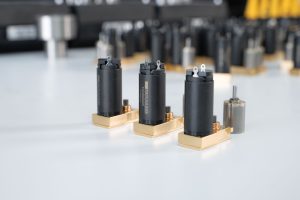 To do this, techniques such as preloaded gear sets can be incorporated to apply a constant force between meshing gears, reducing play and ensuring consistent tooth engagement. When combined with tight manufacturing tolerances, precise shaft and bearing alignment and optimised gear geometries, this helps to ensure that tools respond precisely to control inputs and maintain accurate positioning throughout delicate procedures.
Outside of precision and motion control, gearboxes for neurosurgical instruments must also meet strict spatial and environmental constraints. In minimally invasive and robotic-assisted procedures, space within the instrument housing is extremely limited, yet the gearbox must still deliver high torque and precise motion control. This can still be achieved through choosing planetary or harmonic gearing architectures, which distribute load across multiple gear contacts, increasing torque density and reducing the size of the gear assembly.
Finally, material selection is equally critical as gearboxes must endure repeated autoclave sterilisation cycles without corroding, deforming or fatiguing. For this reason, medical-grade stainless steels, titanium alloys and high-performance polymers such as PEEK are commonly specified. These materials retain mechanical strength and dimensional stability at high temperature and humidity levels, while preventing the generation of particulates that could compromise sterility or performance.
Custom precision gearboxes enable the precise, controlled motion needed for modern neurosurgery. By stabilising and shaping every movement, they allow instruments to reach delicate, previously inaccessible regions of the brain, supporting significant innovations in neurosurgery.
EMS offers a complete custom precision gearbox design service. Get in touch today to discuss the requirements for your next medical device.
For electronics updates please visit: https://efemag.co.uk/category/news