
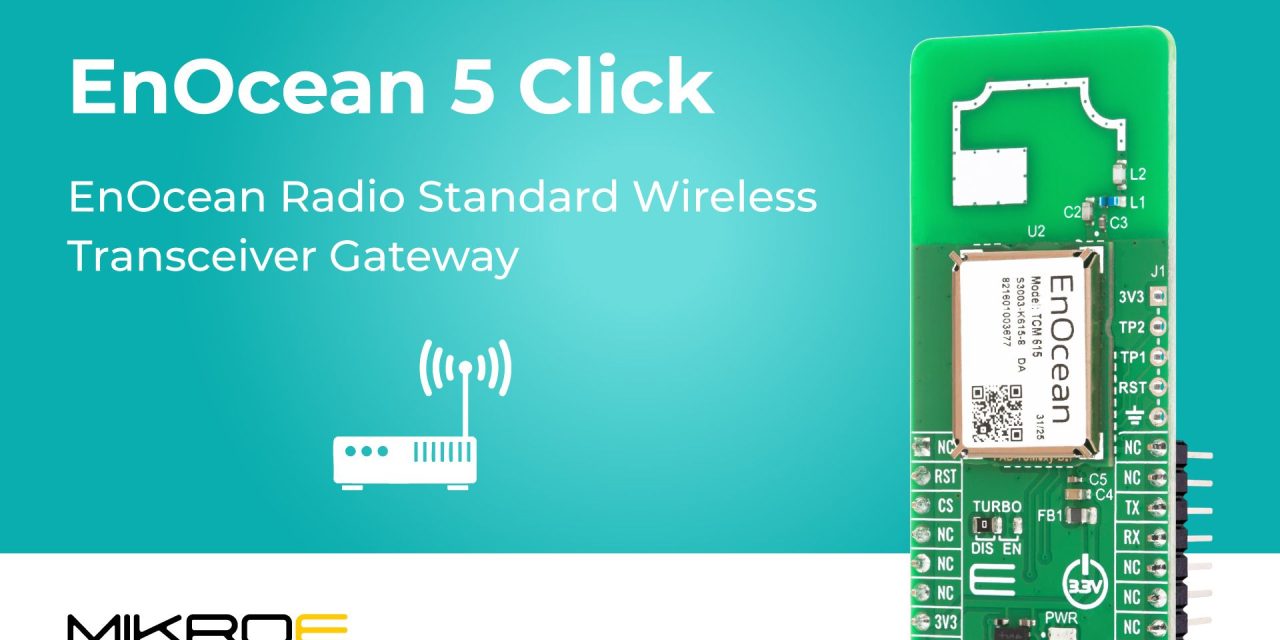
EnOcean 5 Click, a new wireless connectivity Click board from MIKROE, the embedded solutions company that dramatically cuts development time by providing innovative hardware and software products based on proven standards, provides a bidirectional communication interface for EnOcean-based sensors, switches and actuators.
Compact Click add-on boards enable developers to rapidly provide proof-of-concept, then prototype and code new embedded projects.
Nebojsa Matic, CEO of MIKROE Commented: “This new Click board is ideal for developing energy-efficient dimmers, relays and shutter controllers that rely on self-powered EnOcean switches. It is part of our 260+ strong family of wireless connectivity Click boards and over 850 projects – with working code – featuring the EnOcean 5 Click can be found on MIKROE’s embedded projects platform, EmbeddedWiki.”
EnOcean 5 Click is based on the TCM 615 radio transceiver gateway module from EnOcean, which provides an easy to use serial communication interface using EnOcean Serial Protocol version 3 (ESP3). It supports both receiving and transmitting of EnOcean radio telegrams on 868.3MHz using EnOcean Radio Protocol version 1 (ERP1), thanks to its integrated 50Ω RF PCB trace antenna.
Combining a sensitivity of -95dBm with an output power of +10dBm enables robust wireless performance in typical indoor and outdoor environments. The TCM 615 also supports the latest security features defined by EnOcean Alliance, providing encryption, decryption, authentication and replay protection functionality directly on-board. It communicates with external devices such as microcontrollers or processors using the industry-standard UART ESP3 interface supporting baud rates of 57,600bps and 460,800bps.
EnOcean 5 Click is a recent addition to MIKROE’s 1900-strong mikroBUS-enabled Click board family. The board also features the ClickID function which enables automatic identification by the host system, simplifying use. Devices can be used on any host system supporting the mikroBUS standard, and come with the mikroSDK open-source libraries, offering excellent flexibility for evaluation and customisation.
For more electronics updates please visit: https://efemag.co.uk/category/news