Edge AI running entirely on microcontrollers is moving beyond proof-of-concept deployments, with on-device voice interfaces now capable of answering natural language queries using only locally stored documentation.
Demonstrated by Alif Semiconductor, the approach combines speech recognition, deterministic retrieval and speech synthesis on a microcontroller, removing the need for cloud connectivity while keeping operational costs and data transmission to a minimum.
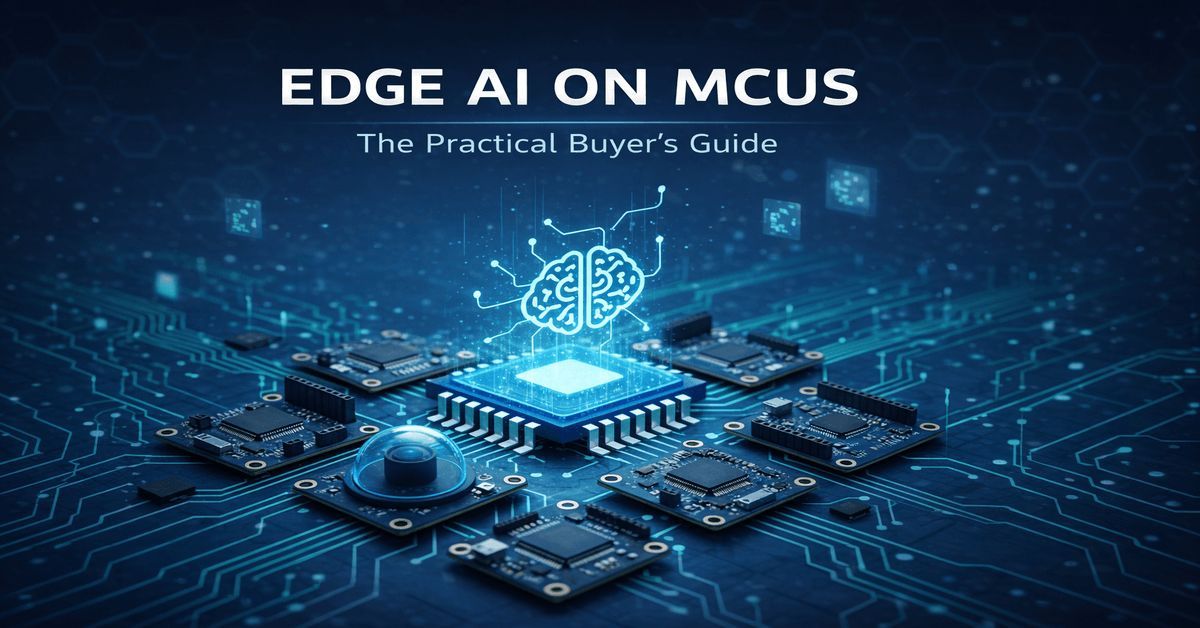
The demo, presented in Alif Semiconductor’s Edge AI MCU Buyer’s Guide, illustrates how embedded AI is expanding beyond inference tasks into complete voice-driven human-machine interfaces that execute entirely on-device.
Deterministic retrieval replaces cloud-based AI responses
Rather than relying on a large language model hosted in the cloud, Alif’s implementation follows a deterministic retrieval architecture. Spoken questions are first converted into text before a local natural language understanding and retrieval engine searches approved documentation for relevant answers. The resulting response is then converted back into speech while displaying supporting illustrations on the device.
According to the YouTube demonstration, the retrieval engine “only provides answers that exist in the official documentation” and will “never invent information.” The system therefore avoids generating responses beyond validated source material, an approach intended to improve predictability for embedded products.
Example demonstrations include vehicle tyre pressure guidance, washing machine troubleshooting and marine navigation settings, with every response generated without an internet connection.
Microcontroller hardware executes the complete AI pipeline
The demonstration uses the Alif Ensemble App Kit, built around Arm Cortex-M55 processors alongside Arm Ethos-U55 neural processing units. According to Alif Semiconductor, the hardware is designed specifically to accelerate AI workloads within microcontroller-class devices while maintaining the low-power characteristics expected from embedded systems.
Unlike architectures that divide speech recognition, retrieval and synthesis between local hardware and cloud services, the complete processing chain executes on the MCU. The demonstration states: “Neural networks [are] running directly on a microcontroller.”
Running the complete pipeline locally removes dependence on network availability while eliminating recurring cloud API charges associated with hosted inference services.
Privacy, certification and manufacturing economics
Alif identifies three commercial advantages of fully local execution.
First, user interactions remain on the device. As demonstrated, “data about what the user asks never leaves the kitchen or the bathroom,” reducing external data transfer requirements.
Second, deterministic retrieval simplifies certification activities. Because responses originate only from approved documentation rather than generated text, system behaviour remains predictable and traceable. According to Alif, this makes the software easier to certify against applicable safety and compliance standards.
Third, manufacturers avoid recurring cloud infrastructure costs. The demonstration states that eliminating cloud APIs results in “zero operational cost” after deployment for both manufacturers and end users.
These characteristics may prove particularly relevant for appliances, industrial equipment, automotive interfaces and marine electronics where products often remain in service for many years and may operate with limited or intermittent connectivity.
Edge AI expands the role of the embedded MCU
The Alif Semiconductor buyer’s guide describes a wider trend towards increasingly capable AI-enabled microcontrollers, combining higher compute performance with integrated neural processing acceleration for embedded inference workloads.
As speech interfaces become more common across connected products, executing recognition, retrieval and voice synthesis entirely on-device removes reliance on external infrastructure while preserving deterministic system behaviour. Rather than treating the MCU as a simple control processor, manufacturers are beginning to integrate AI capabilities directly into the embedded platform itself.
The result is an architecture where voice assistance can operate continuously without cloud dependence, subscription costs or external data processing, while ensuring every response remains grounded in approved product documentation.
Damian Semple, franchise marketing manager, comments: “Running voice AI entirely on a microcontroller changes the sourcing conversation because the processing capability sits within the embedded hardware rather than depending on external cloud infrastructure. As these devices become part of long product lifecycles, selecting components with the right AI performance, longevity and supply support from the outset will become increasingly important.”
Explore Alif Semiconductor’s product portfolio
For more electronics updates please visit: https://efemag.co.uk/category/news